
Gravel Driveways
Stop gravel migrating, rutting and sinking. IBRAN grids lock the stone in place so a gravel driveway stays level, drains freely and needs almost no raking.
Get a price for your project
Recommended systems for this application
Why reinforcement matters here
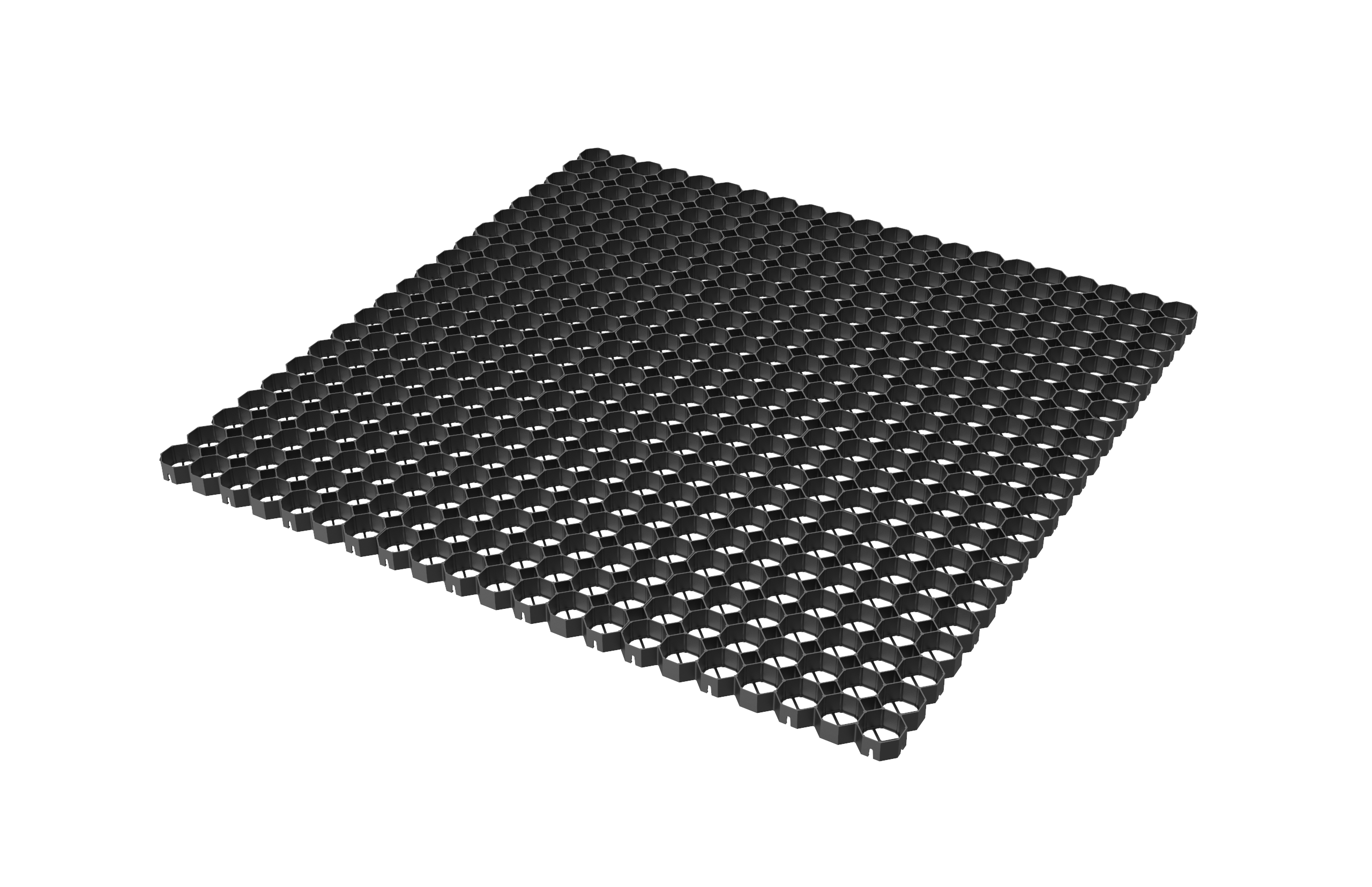
Loose gravel is only as good as what sits under it. Without confinement, stone migrates to the edges, ruts form in the wheel tracks and puddles collect in the hollows. IBRAN-X cellular grids hold each stone within a cell, spreading load across the whole surface rather than concentrating it under the tyre. The result is a driveway that stays where you put it.
Where this works well
At a glance
| Sub-base | 50-80mm MOT Type 1 (100-150mm for regular van traffic) |
|---|---|
| Infill | Angular 10-20mm gravel, filled level plus a 5-10mm blinding |
| Typical loading | Cars, light vans and occasional delivery vehicles |
| Permeability | Fully permeable. Normally treated as a SuDS component in a drainage strategy. |
| Design life | 25 years, subject to documented installation. |
| Material | 100% recycled polypropylene, made in the UK. |
How it goes in
- Mark out the area and excavate to the depth of your sub-base plus the grid depth plus your infill blinding.
- Lay a woven geotextile across the formation, lapping joins by at least 300mm. This stops the sub-base and the subsoil mixing.
- Lay and compact the sub-base: 50-80mm MOT Type 1 (100-150mm for regular van traffic). Compact in layers rather than all at once.
- Blind the sub-base with a thin layer of grit sand and screed it level. This is what gives you a flat finished surface.
- Push-fit the grids together across the area, working from one edge. Cut around obstacles with a jigsaw or fine-tooth saw.
- Fill the cells: Angular 10-20mm gravel, filled level plus a 5-10mm blinding. Work the fill in with a stiff brush so no cell is left hollow.
- Check the finished level. Nothing should stand proud of the cell walls, and no cell should be left under-filled.
Most installations are straightforward groundwork. The grids themselves push-fit together and need no fixings, adhesive or specialist tools.
Which grid depth?
The 30mm heavy duty grid is the right choice for a gravel driveway. It is the stronger of the two, and with 25% more units per pallet it works out better value over a driveway-sized area. The 40mm general duty grid is an option where the same surface also has to carry grass.
If you are between two options, take the heavier duty one. The cost difference across a typical project is small next to the cost of lifting and relaying a surface that was under-specified.
The mistake we see most often
The most common failure is too much gravel on top. Anything over about 10mm above the cell walls is unconfined stone, and unconfined stone migrates. If you can see ruts forming in the top layer, the fill is too deep.
Common questions
How much gravel do I need on top?
Fill the cells level and add a 5mm to 10mm blinding layer over the top. Any deeper and the stone above the grid can still migrate.
What size gravel works best?
Angular stone between 10mm and 20mm. Angular pieces interlock; rounded pea shingle rolls and will always be less stable.
Do I need a sub-base?
For cars, 50mm to 80mm of compacted MOT Type 1 is plenty. For regular van or delivery traffic, go to 100mm to 150mm.
Can I lay it on a slope?
Yes. Grids are particularly effective on slopes because the cell walls stop stone washing downhill in heavy rain.
Do I need to remove the existing driveway?
If it is loose gravel, usually not. Rake it out, compact it and check the levels. If it is broken tarmac or concrete, it has to come up or you will have no drainage path.
How long does installation take?
A typical two-car driveway of around 40m2 is a weekend job for two people, excluding excavation and muck-away.
Ask our engineer
Questions about depths, sub-base, edging or which system fits your project? Ask below.